The Indian Obsession With Winning
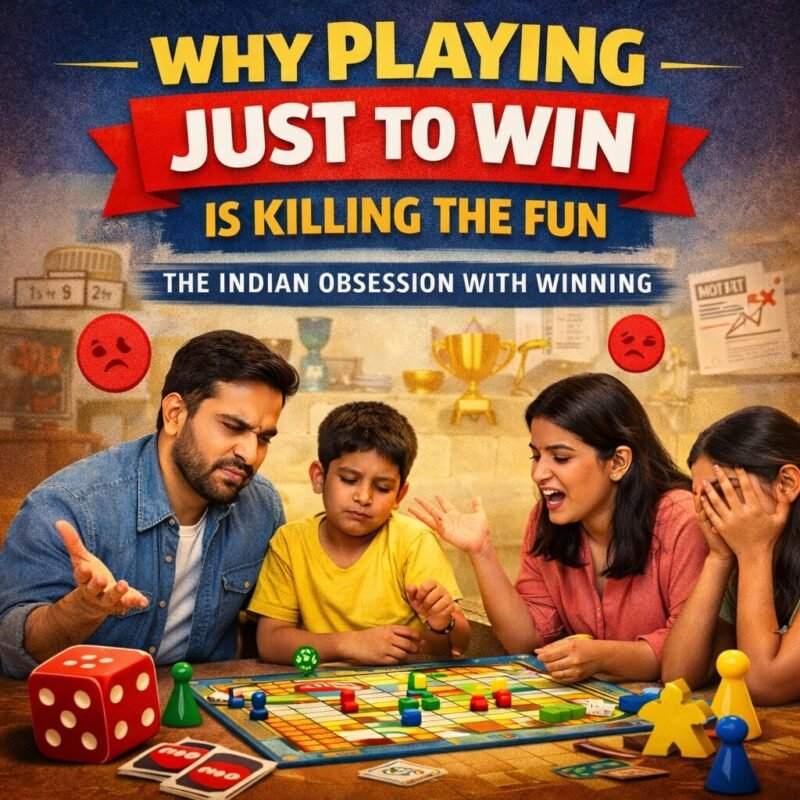
Let’s start with a very Indian situation. A family is playing a game. Someone makes a wrong move.
Immediately, another person says:
“Arre! Aise kaun karta hai?”
Someone else replies:
“Rules samjhe bhi ho kya?”
And five minutes later, the game is over — not because someone won, but because someone got upset.
If this feels familiar, you’re not alone.
In India, we are trained to take results very seriously.
Marks, ranks, packages, scores — everything is measured.
So naturally, when we play games, we bring the same mindset:
Play to win. At any cost.
But here’s the interesting part.
Some of the most loved board games in the world
are not designed for people who only want to win.
They are designed for people who want to experience the game.
Where Did This “Win at All Costs” Mindset Come From?
Think about our childhood.
Sports Day meant:
• First prize
• Second prize
• Everyone else watching
Board exams meant:
• Toppers’ photos on banners
• Everyone else hearing, “Bas theek hi hai”
Over time, we internalised one idea:
If you didn’t win, it didn’t matter.
But games were never meant to mirror exams or corporate appraisals.
Games were meant to:
• Experiment
• Fail safely
• Try again
Modern board game designers understand this very well. That’s why many games don’t reward aggression.
They reward observation, creativity, and collaboration.
What “Play to Play” Actually Means
“Play to play” does not mean:
• Nobody cares
• Everyone gets a trophy
• Winning doesn’t exist
Winning still exists.
But it’s not the only source of enjoyment. Let’s take some examples.
Dixit
You don’t win by being the smartest.
You win by understanding how others think.
Codenames
The best moments are not victories —
they are wrong guesses that make everyone laugh.
The Mind
Players don’t even speak.
They try to synchronise silently.
In all these games:
• Losing doesn’t feel humiliating
• Winning doesn’t feel aggressive
You finish the game thinking:
“That was interesting. Let’s play again.”
That’s a very different emotion from:
“Bas, ho gaya.”
Why Losing Feels So Bad to Us
Here’s a hard truth. Most of us were never taught how to lose properly.
In schools:
Losing meant “could have done better”
In families:
Losing meant comparison
In workplaces:
Losing means consequences
So when we lose in a game, our brain doesn’t treat it as play.
It treats it as judgement.
Board games — when played with the right mindset —
create a rare environment where:
• Losing has no long-term cost
• Mistakes are visible but temporary
• Everyone resets at the next round
Psychologists call this low-stakes failure.
This is extremely important for:
• Children, who are afraid to make mistakes
• Adults, who are tired of being evaluated
Games give permission to fail — publicly — without damage.
Why Youth Connects Deeply With This Idea
Young Indians today are under constant pressure.
Competitive exams.
Career comparisons.
Social media perfection.
Everything feels like a scoreboard.
That’s why games where you:
• Cooperate
• Improvise
• Laugh at mistakes
feel refreshing.
This is one reason why:
• College board game clubs are growing
• Board game cafés attract first-time players
• Cooperative games are becoming more popular than pure competitive ones
People don’t want one more place to prove themselves.
They want a place where they can just be present.
What This Teaches Us Outside the Game
The lessons from “play to play” don’t stay on the table.
People who play such games regularly tend to:
• Listen more
• Take turns patiently
• Handle disagreement calmly
• Separate identity from outcome
In simple terms:
They don’t take everything personally.
This is why many educators and therapists now recommend
tabletop games as social tools, not just entertainment.
Not to make people winners —
but to make them comfortable participants.
Redefining What Fun Means
Winning is enjoyable. No doubt about that. But when winning becomes the only reason to play,
games stop being fun and start feeling like work.
Board games remind us of something very basic:
You don’t always play to prove something.
Sometimes, you play to experience something.
And once you experience that kind of play,
you realise something important.
The real victory is not winning the game —
it’s wanting to play again.
— Ajay A.