LEARNING WITHOUT THE BURDEN
In India, the word learning carries baggage.
It usually means:
- Syllabus
- Exams
- Pressure
- Someone standing in front of you explaining
Very rarely does learning feel light.
Now imagine this situation.
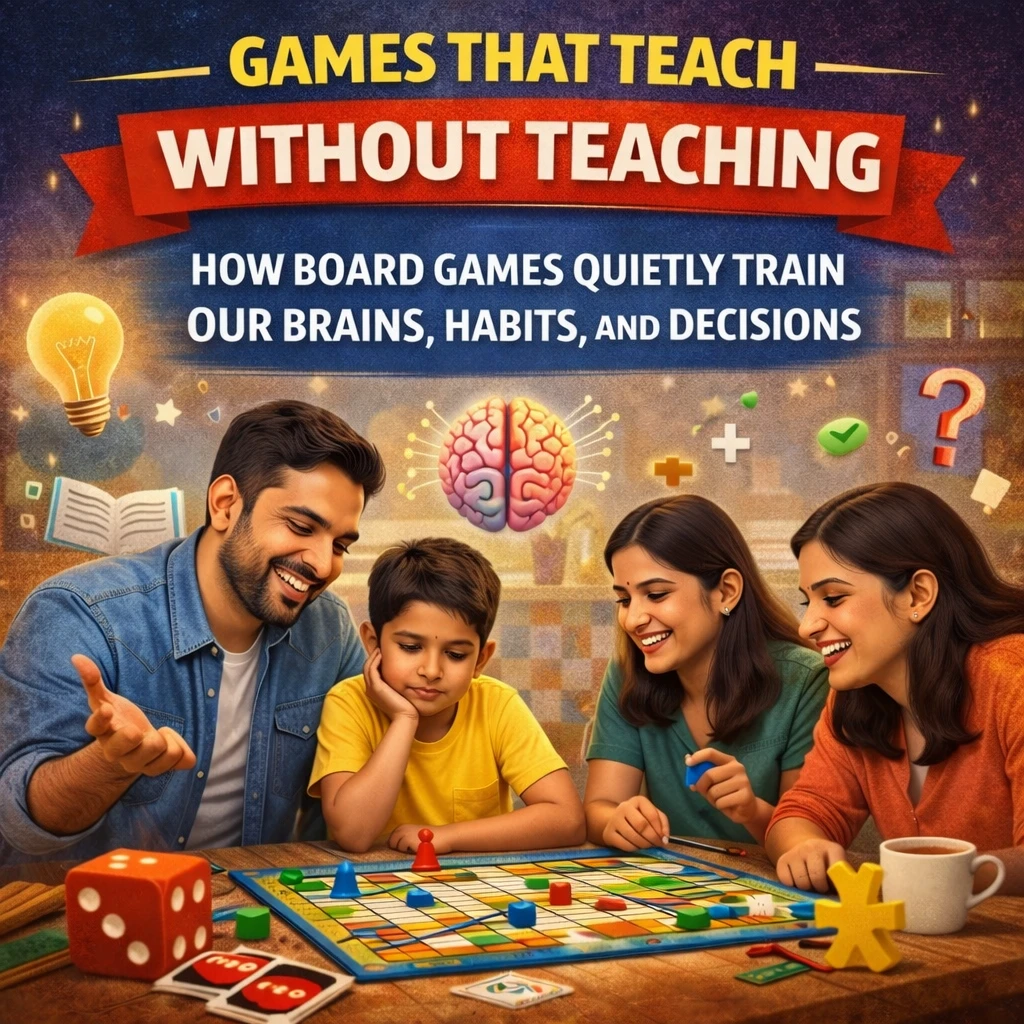
You’re sitting at a table.
You’re laughing, arguing, making plans.
You’re completely involved.
And later, without realising it, you’ve learnt:
- How money flows
- Why cooperation matters
- How bad decisions compound
- Why communication breaks teams
That is exactly what good board games do.
They don’t announce lessons.
They create situations.
WHY BOARD GAMES ARE PERFECT EDUTAINMENT
Board games are built around systems.
A system has:
- Rules
- Resources
- Constraints
- Consequences
You make a decision.
The system responds.
You adjust.
This is how real life works.
That’s why educators call board games
experiential learning tools.
You don’t memorise concepts.
You feel them.
Let’s look at some famous examples.
MONEY, ECONOMICS & FINANCIAL THINKING
Monopoly — Cash Flow & Inequality
Everyone has played Monopoly.
Most people remember the fights, not the lesson.
But Monopoly quietly teaches:
- How assets generate income
- Why owning property early matters
- How rent compounds advantage
- Why wealth concentration is hard to reverse
People realise something uncomfortable:
Once someone pulls ahead,
the system itself helps them stay ahead.
That’s not just a game lesson.
That’s basic economics.
Power Grid — Supply, Demand & Infrastructure
Power Grid is a serious strategy game.
Players run power companies.
They must:
- Buy fuel at auctions
- Expand networks efficiently
- Balance cost vs reach
This game teaches:
- Demand forecasting
- Resource scarcity
- Infrastructure planning
- Why late expansion is expensive
Many players say:
“I finally understood how pricing works.”
COOPERATION, CRISIS & SYSTEMIC THINKING
Pandemic — Crisis Management & Collective Responsibility
Pandemic is a cooperative game.
Either everyone wins, or everyone loses.
Players manage global disease outbreaks.
They must decide:
- Where to allocate limited resources
- Which crisis to ignore temporarily
- When to sacrifice short-term gains
The game teaches:
- Systems thinking
- Risk prioritisation
- The cost of delayed action
- Why coordination matters more than heroics
Many people who played Pandemic during COVID
said the game suddenly felt… very real.
Forbidden Island / Forbidden Desert — Team Coordination
These games teach:
- Shared responsibility
- Clear communication
- Role-based collaboration
They show how:
One weak link can sink the team.
But one smart coordination can save everyone.
NEGOTIATION, PSYCHOLOGY & HUMAN BEHAVIOUR
Catan — Negotiation & Trade Psychology
Catan is not about luck or intelligence.
It’s about people.
You learn:
- When to negotiate
- When to say no
- How relationships affect outcomes
- Why timing matters more than resources
People often discover:
“I’m bad at negotiation.”
Or:
“I give away too much.”
That insight is priceless.
Modern Art (Auction Game) — Market Psychology
In Modern Art, players buy and sell paintings.
The twist?
Value is created by perception, not quality.
The game teaches:
- How hype influences price
- Why early movers profit
- How markets are shaped by belief
Suddenly, stock markets make more sense.
COMMUNICATION, CREATIVITY & EMPATHY
Codenames — Communication Precision
This game teaches:
- How hard it is to give clear instructions
- How assumptions create misunderstandings
- Why fewer words need better thinking
Perfect for:
- Teams
- Families
- Workplace groups
Dixit — Creativity & Perspective
Dixit rewards:
- Imagination
- Emotional intelligence
- Understanding how others think
You don’t win by being obvious.
You win by being just relatable enough.
That’s a subtle life lesson.
WHY THIS KIND OF LEARNING STICKS
Here’s the difference.
Traditional learning says:
“Remember this concept.”
Games say:
“Live through this situation.”
And what you live through,
you remember longer.
Board games teach:
- Without fear
- Without judgement
- Without exams
They don’t make you smarter overnight.
They make you more aware.
And awareness is where learning actually begins.
Board games don’t replace education.
They complete it.
They teach:
- What textbooks struggle to explain
- What lectures can’t simulate
- What experience usually teaches too late
And they do it
while people are laughing.
That’s edutainment at its best.